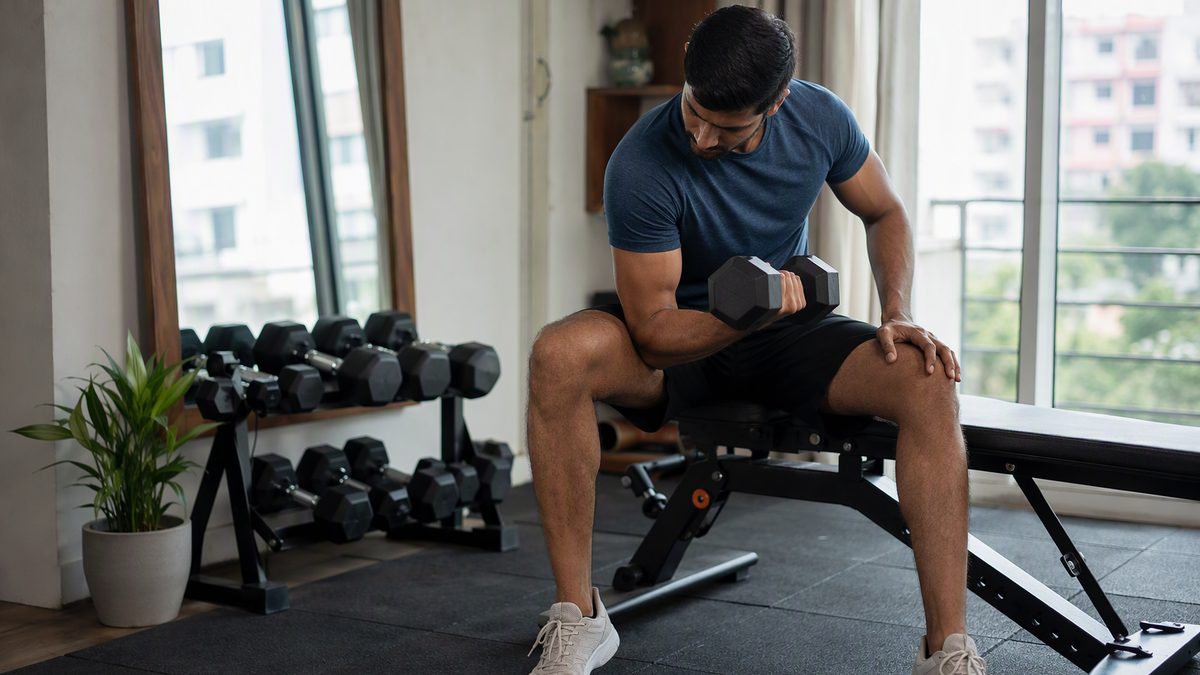
💡 Quick Answer
A useful apartment home gym in India needs about 2 m × 2 m of floor, a rubber base to protect tiles, and three core items: dumbbells, a foldable adjustable bench and a doorway pull-up bar. At the time of writing, that core setup costs roughly ₹15,000–₹20,000; a mat, bands and pull-up bar alone cost under ₹3,000.
- Use 10–15 mm rubber tiles on vitrified or marble floors; 20 mm if you lift heavy.
- Spin-lock dumbbell kits are cheapest; dial-adjustable dumbbells save time and space.
- Fixed pairs make sense when several people in the house train.
- Check doorframes, ceiling height and society rules before buying.
Long commutes, crowded gyms at 7 pm and monthly fees that keep rising have pushed many people in Indian cities to train at home. The problem is that most guides assume a garage. This one is written for a 1BHK or 2BHK flat with tiled floors, neighbours below and a fixed budget in rupees.
How Much Space You Actually Need
A clear floor area of about 2 m × 2 m (roughly 43 sq ft) is enough for dumbbell training, a bench and floor work. That fits in a balcony corner, the end of a living room or a spare bedroom. Before you buy anything, check three things:
- Ceiling height: stand where you will train and press your arms straight overhead with a broomstick. If you clear the fan and the ceiling with room to spare, overhead pressing is fine.
- Doorframes: doorway pull-up bars need a solid frame of the right width. Many Indian interior doors are wooden frames set in brick, which usually hold well; hollow or plywood frames may not.
- Storage: where the dumbbells and bench go when guests come over. A foldable bench and a compact dumbbell set make a huge difference in a small flat.
Flooring for Indian Apartments
Vitrified tiles, marble and granite crack when a dumbbell lands on them, and they are slippery when sweaty. Neighbours below will also hear every dropped weight. Put a proper base down before you lift anything heavy.
| Option | Best for | Price at the time of writing | Notes |
|---|---|---|---|
| Yoga or exercise mat (6 mm) | Bodyweight, bands, stretching | About ₹500–₹1,000 | Not enough under dumbbells |
| EVA interlocking foam tiles | Light dumbbell work | Cheaper than rubber | Compresses and dents under heavy weights |
| Rubber gym tiles, 10–15 mm | Dumbbells and a bench | About ₹55–₹85 per sq ft | Good default for apartments |
| Rubber gym tiles, 20 mm+ | Heavy deadlifts, any dropping | About ₹100 per sq ft and up | Best noise and floor protection |
For a 2 m × 2 m area, 10 mm rubber tiles come to roughly ₹2,400 and 20 mm tiles to about ₹4,300 at those rates. Lay them wall to wall in your training zone so the bench legs and dumbbells are always on rubber.
Coastal cities: in Mumbai, Chennai or Kochi humidity, bare iron plates and bars rust quickly. Choose rubber- or chrome-coated weights, wipe them after sessions, and keep them off the balcony during the monsoon.
Home Gym Budget Tiers in ₹
Prices below are approximate retail prices seen on Decathlon, Amazon, Flipkart and brand stores at the time of writing (October 2026). They change with sales, so treat them as a guide to what each tier involves, not a quote.
| Tier | What you buy | Approx. total | Good for |
|---|---|---|---|
| 1. Starter | Exercise mat, a set of resistance bands, doorway pull-up bar | Under ₹3,000 | Beginners, bodyweight and band training |
| 2. Core | Tier 1 + a 20 kg spin-lock dumbbell kit, a foldable adjustable bench, 10 mm rubber tiles | About ₹15,000–₹20,000 | Most people for the first 1–2 years |
| 3. Serious | Tier 2 but with dial-adjustable dumbbells (up to 24 kg each), 20 mm flooring, a kettlebell | About ₹25,000–₹35,000 | Intermediate lifters short on space |
| 4. Full setup | Squat stand or rack, barbell, plates, heavier flooring | Varies widely | Ground-floor flats or independent houses |
Individual items at the time of writing: doorway pull-up bars around ₹700–₹3,000; adjustable foldable benches around ₹4,000–₹8,000; Decathlon's 20 kg Domyos adjustable dumbbell kit around ₹6,000 on sale (list price about ₹9,000); dial-adjustable 24 kg dumbbells around ₹13,000–₹18,000 a pair from budget brands, and more for premium ones.
Tier 4 needs more thought than money. A rack and barbell can weigh several hundred kilograms with plates, so on an upper floor check with your society about load and noise before buying.
Adjustable Dumbbells vs Fixed Dumbbells
Dumbbells are the most useful thing you will buy, and the choice between adjustable and fixed decides how much space and money the rest of your setup takes.
| Spin-lock (threaded) kit | Dial / selector adjustable | Fixed pairs | |
|---|---|---|---|
| Space | Small case or two bars | Very compact: two units in a tray | Needs a rack for several pairs |
| Changing weight | Slow: unscrew collars, swap plates | Seconds: turn a dial | Instant: pick up another pair |
| Cost | Lowest | Highest per pair | Adds up as you buy more pairs |
| Durability | Very durable; collars can loosen | Mechanism can break if dropped | Most durable |
| Max weight | Usually 10–20 kg per hand with extra plates | Commonly up to 24 kg each in India | Whatever you buy |
| Best for | Beginners on a budget | Small flats, supersets, quick changes | Families, several users, HIIT |
Our recommendation: start with a spin-lock kit if money is tight; move to dial-adjustable dumbbells once you are training consistently and changing weights often. Buy one or two fixed pairs (for example 5 kg and 10 kg) later if more than one person in the house trains.
What You Can Train with a Tier 2 Setup
Dumbbells, a bench, bands and a pull-up bar cover every major movement pattern:
- Legs: goblet squats, Bulgarian split squats, Romanian deadlifts, step-ups.
- Push: dumbbell bench press, incline press, overhead press, push-ups.
- Pull: pull-ups or band-assisted pull-ups, one-arm rows, band face pulls.
- Core and carries: farmers carries in the corridor, dead bugs, planks.
That is enough to build muscle for a long time if you keep adding reps and weight. For ready-made routines, see our dumbbell workout plan for home, the no-equipment home workout plan for Tier 1, or let the AI workout planner build sessions around exactly the equipment you own.
Training Without Upsetting the Neighbours
- Lower dumbbells to the floor instead of dropping them, especially after the last rep.
- Avoid jumping exercises late at night or early in the morning; swap jump squats for slow tempo squats.
- Put the bench and weights away from the shared wall if you have one.
- Check your society's rules if you plan to install a wall-mounted bar or rack.
Frequently Asked Questions
How much does a home gym cost in India?
At the time of writing, a starter setup of mat, bands and pull-up bar costs under ₹3,000. A core setup with a 20 kg dumbbell kit, foldable bench and rubber flooring costs about ₹15,000 to ₹20,000.
How much space do I need for a home gym in an apartment?
About 2 m by 2 m of clear floor, roughly 43 sq ft, is enough for dumbbells, a bench and floor exercises. Check ceiling height for overhead presses and keep storage space for when the area is needed.
Are adjustable dumbbells worth it?
Yes for most apartments. They replace several pairs of fixed dumbbells in a small footprint. Spin-lock kits are cheapest; dial-adjustable dumbbells change weight in seconds but cost more and should not be dropped.
What flooring is best for a home gym on tiles?
Rubber gym tiles of 10 to 15 mm are a good default for dumbbell training on vitrified or marble floors. Use 20 mm or thicker if you deadlift heavy or might drop weights.
Can I build muscle with only a home gym?
Yes. Dumbbells, a bench, bands and a pull-up bar cover squats, hinges, presses and rows. Progress comes from steadily adding reps and weight, which a home setup allows.
Want a plan built around your training history? UltraFit360's free AI workout planner creates and adjusts programs for you.
Transform Your Fitness Journey
Log your workouts, track your diet, and get AI coaching insights — all with UltraFit360.