💡 Quick Answer
Incline walking works for fat loss because it burns far more calories than flat walking with very little joint impact. The 12-3-30 workout (12% incline, 3 mph, 30 minutes) is roughly an 8-MET effort, so it is zone 2 only for fitter people. Many beginners land above zone 2; check with a heart-rate monitor or the talk test.
- Is 12-3-30 zone 2? It depends on your fitness. If you can speak in full sentences and your heart rate sits around 60–70% of max, yes. If you can only get out a few words, you are above zone 2.
- 12% vs 13% incline: 12% means 12 feet of climb per 100 feet travelled (about 6.8°); 13% is about 7.4° and costs roughly 5% more energy at 3 mph.
- Calories: a 12-3-30 session burns very roughly 210–260 calories at 120 lb and 320–390 at 180 lb. Heavier people burn more. In a 2025 laboratory study of 12-3-30 (Wong et al., International Journal of Exercise Science), the 30-minute session averaged about 308 kcal (SD 59) in recreationally active adults who did not hold the rails.
- Fat loss still comes from an overall calorie deficit; pair incline walking with strength training and adequate protein.
Treadmill walking has a reputation problem. Steady walking at a flat grade looks boring on paper, and the calorie numbers seem underwhelming compared to a hard run or a HIIT session. Add a meaningful incline and the math changes. Incline walking recruits more muscle, raises your heart rate, and does it without the joint stress of running. The 12-3-30 protocol, popularised on YouTube and TikTok by Lauren Giraldo, turned this idea into a viral workout. Understanding what it actually asks of your body lets you use incline walking as a long-term fat-loss tool rather than a trend.
What Is the 12-3-30 Workout?
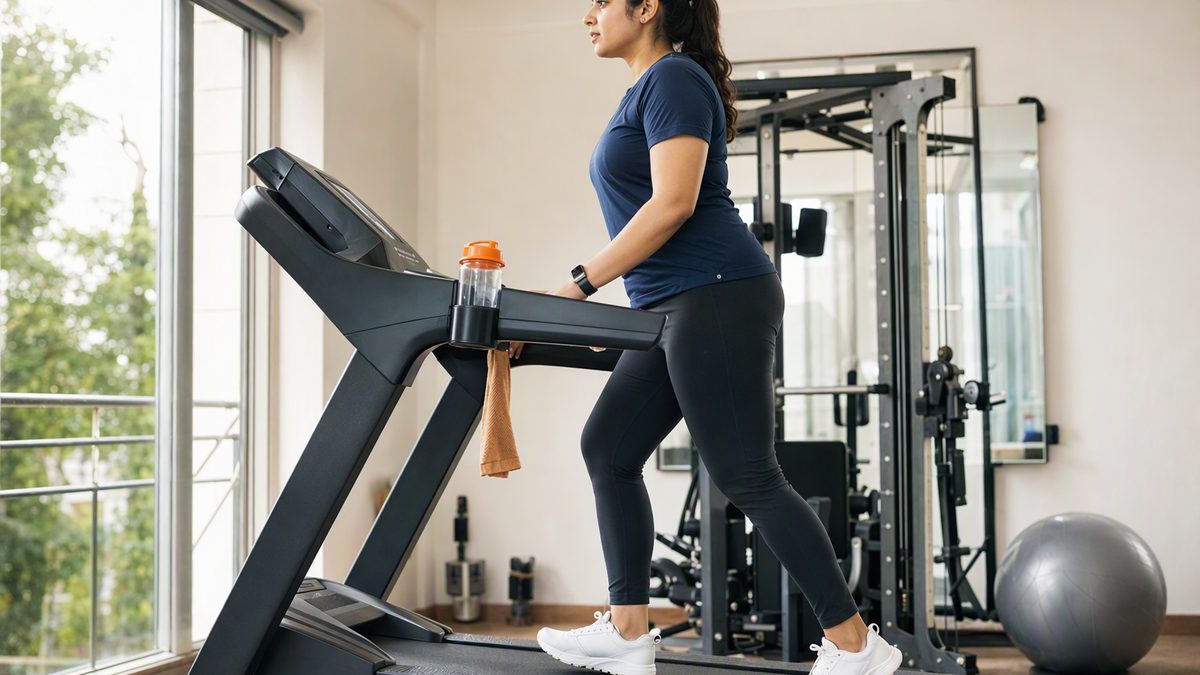
The protocol is exactly what it sounds like: set the treadmill to a 12 percent incline, walk at 3 miles per hour, and go for 30 minutes. No running, no intervals. Twelve percent is steep enough to challenge your heart and lungs and load the glutes and hamstrings, while 3 mph is slow enough that most people can walk rather than jog.
For someone who is deconditioned, carries extra weight, or is returning from injury, 12-3-30 as written may be too aggressive at first. That is not a failure; it is information. Reasonable starting modifications:
- Reduce the incline to 6–8 percent until 30 minutes feels manageable, then increase by 1 percent at a time
- Shorten the duration to 15–20 minutes and add a few minutes each week
- Slow the speed to 2.5 mph if 3 mph makes you grip the rails
- Use intervals: 2 minutes flat, 3 minutes steep, progressing toward continuous incline over several weeks
Is 12-3-30 Zone 2?
Sometimes, but not for everyone. Zone 2 is usually defined as roughly 60–70 percent of your maximum heart rate: an easy-to-moderate effort you could hold for a long time while still talking comfortably. Whether 12-3-30 lands there depends on your fitness, body weight and age, not on the treadmill settings themselves.
Using the standard ACSM walking equation, walking at 3 mph up a 12 percent grade costs about 8 METs (eight times your resting energy use). ACSM classes anything at or above 6 METs as vigorous activity. A fit, regular exerciser may still be in zone 2 at that workload. A beginner, or someone carrying more body weight, will often be in zone 3 or higher, especially in the second half of the session as heart rate drifts upward.
How to check for yourself:
- Heart-rate method: estimate your max as 220 minus your age (a rough estimate; individuals vary a lot). Zone 2 is about 60–70 percent of that. For a 40-year-old, that is roughly 108–126 beats per minute. Check your heart rate around minutes 20–25, not just at the start.
- Talk test: in zone 2 you can speak in full sentences, a little breathier than normal. If you can only manage a few words at a time, you are above zone 2.
- Breathing: if you are breathing hard through your mouth and can't slow it down, you are working harder than zone 2.
If you are above zone 2 and want a true zone 2 session, lower the incline (try 6–10 percent) or slow to 2.5–2.8 mph until your heart rate and breathing settle. If you are simply after calorie burn and feel good, working a bit above zone 2 is fine; it just is not the same session.
12% vs 13% Incline: What the Numbers Mean
Treadmill incline is shown as a percentage grade: vertical rise divided by horizontal distance. A 12 percent incline means you climb 12 feet for every 100 feet you travel forward. It feels steep, but it is only about 6.8 degrees.
| Treadmill setting | Angle | Rise per 100 ft | Estimated effort at 3 mph |
|---|---|---|---|
| 0% (flat) | 0° | 0 ft | About 3.3 METs (light to moderate) |
| 6% | About 3.4° | 6 ft | About 5.8 METs (moderate) |
| 12% (12-3-30) | About 6.8° | 12 ft | About 8.3 METs (vigorous) |
| 13% | About 7.4° | 13 ft | About 8.7 METs (vigorous) |
| 15% | About 8.5° | 15 ft | About 9.5 METs (vigorous) |
MET estimates come from the ACSM walking equation and assume you are not holding the rails. Going from 12 to 13 percent adds roughly 5 percent to the energy cost at 3 mph. That makes 13 percent a sensible next step once 12-3-30 feels easy, not a dramatically different workout. Many treadmills top out at 15 percent.
How Many Calories Does 12-3-30 Burn?
Calorie burn depends mostly on body weight: moving a heavier body uphill takes more energy. The ranges below are estimates from the ACSM walking equation for a 30-minute session at 3 mph, with a margin either side because real people, treadmills and walking styles vary. They are total (gross) calories, including the energy you would burn at rest anyway.
| Body weight | Flat, 3 mph, 30 min | 12% incline (12-3-30) | 13% incline, 3 mph, 30 min |
|---|---|---|---|
| 120 lb (54 kg) | About 80–100 | About 210–260 | About 220–270 |
| 150 lb (68 kg) | About 110–130 | About 270–320 | About 280–340 |
| 180 lb (82 kg) | About 130–160 | About 320–390 | About 340–410 |
| 210 lb (95 kg) | About 150–180 | About 370–450 | About 390–480 |
Treat treadmill and watch readouts as rough guides too; they use similar formulas and can be well off for an individual. Holding the rails lowers the real number. For fat loss, what matters is the weekly total and your overall calorie balance, not any single session.
Why Incline Walking Helps With Fat Loss
The mechanism is simple: lifting your body mass uphill takes far more work than moving it on the flat, and laboratory measurements show the energy cost of walking rising as the gradient steepens (Minetti et al., 2002). At 3 mph, a 12 percent grade roughly doubles to triples the energy cost of flat walking, as the tables above show, while keeping impact low.
- Higher calorie burn than flat walking at the same speed
- Low joint impact compared with running, which makes it easier to repeat
- Sustainable frequency: many people can do it several days a week without needing long recovery
- Easy to progress in small steps by changing incline, speed or duration
One caveat: the idea of a special "fat-burning zone" is often oversold. In the 2025 laboratory comparison, 12-3-30 drew a higher share of its energy from fat than a run matched for total calories, but it took longer to burn the same amount; fat loss over weeks comes from your total energy balance. Incline walking is useful because it lets you burn a meaningful number of calories in a way you can sustain.
Form and the Rail Rule
The most common mistake in incline treadmill walking is holding the side rails. Gripping them shifts load off your legs, reduces how hard your body has to work, and lowers your heart rate, so the calories on the display overstate what you actually burned.
If you need to hold the rails to finish, the settings are too aggressive. Lower the incline or speed until you can walk with your arms swinging freely.
- Lean forward slightly from the ankles, not by bending at the waist
- Land through your heel and midfoot rather than staying on your toes, which reduces calf strain
- Keep your core lightly braced and your chest up
- Let your arms swing naturally with bent elbows
- Look forward, not down at your feet
Posterior Chain Benefits Beyond Calorie Burn
Incline walking also works the glutes, hamstrings and calves. Each uphill step requires more hip extension than flat walking, which puts more demand on the glutes and hamstrings. That makes it a useful counterweight for people who sit for long periods during the day, without needing a complex strength routine.
Progressing Beyond 12-3-30
Once 12-3-30 feels comfortable (you can finish without the rails and your heart rate stays where you want it), change one variable at a time:
- Extend duration to 35, then 40, then 45 minutes
- Increase incline from 12 to 13 or 14 percent
- Increase speed from 3.0 to 3.2 or 3.5 mph, watching your heart rate
- Add a weighted vest (start light, around 10 lb) to increase load without changing settings
- Use incline intervals, for example 2 minutes at 15 percent and 2 minutes at 6 percent
Stick with one approach for a few months. Results come from consistency and gradual progression, not from switching protocols every few weeks.
Building Incline Walking Into a Fat-Loss Plan
Incline walking works best alongside resistance training, not instead of it. Strength training helps you keep muscle while you are in a calorie deficit; incline walking adds calorie burn without much extra recovery cost.
- Three to four incline walking sessions per week, each 30–45 minutes
- Two to three resistance training sessions per week
- At least one full rest day per week
- A moderate calorie deficit with enough protein, rather than a crash diet
Sleep and stress matter more than most people expect: poor sleep makes hunger harder to manage and training harder to recover from.
Logging your incline walks in UltraFit360, including duration, incline, speed and heart rate, makes progress visible: the same 12-3-30 session should feel easier and produce a lower heart rate over the weeks. That is your cue to progress.
Frequently Asked Questions
Is 12-3-30 zone 2?
It depends on your fitness. 12-3-30 is roughly an 8-MET effort, which ACSM classes as vigorous. Fitter people may stay in zone 2 (about 60–70% of max heart rate), but many beginners will be above it. Use a heart-rate monitor or the talk test: if you can only say a few words at a time, you are above zone 2.
Is incline walking good for fat loss?
Yes. Incline walking burns roughly two and a half times more calories than flat walking at the same speed with low joint impact, so it is easy to do several times a week. Fat loss still depends on an overall calorie deficit, so combine it with sensible eating and strength training.
What does 13% incline mean on a treadmill?
A 13% incline means the belt rises 13 feet for every 100 feet of horizontal distance, about 7.4 degrees. Compared with 12%, it adds roughly 5% to the energy cost at 3 mph, so it is a natural next step once 12-3-30 feels easy.
How many calories does the 12-3-30 workout burn?
Very roughly 210–260 calories for a 120 lb person, 270–320 at 150 lb, 320–390 at 180 lb and 370–450 at 210 lb, based on the ACSM walking equation. Your actual number depends on body weight, fitness and whether you hold the rails.
How often should I do the 12-3-30 workout?
Three to four times per week is a sustainable target for most people, alongside two to three strength sessions. If 30 minutes at 12% is too hard at first, start at a lower incline or shorter duration and build up over several weeks.
Is it OK to hold the rails during 12-3-30?
Try not to. Holding the rails takes load off your legs and lowers the real calorie burn and heart rate. If you need the rails to finish, reduce the incline or speed until you can walk hands-free.
Sources
- Wong MWH, Davis DW, Perez OR, Weyers B, Green DM, Garcia AV, Navalta JW. An exploratory study comparing the metabolic responses between the 12-3-30 treadmill workout and self-paced treadmill running. International Journal of Exercise Science, 2025;18. doi:10.70252/UBIX5911 (PMID 39917588)
- Minetti AE, Moia C, Roi GS, Susta D, Ferretti G. Energy cost of walking and running at extreme uphill and downhill slopes. Journal of Applied Physiology, 2002;93. doi:10.1152/japplphysiol.01177.2001 (PMID 12183501)
Set your targets with the free calorie and macro calculator, then build a day of meals with the meal plan generator.
Transform Your Fitness Journey
Log your workouts, track your diet, and get AI coaching insights — all with UltraFit360.